German Bund spread betting

German Bund spread betting

The German Bund is a fixed-interest security issued by the German government to finance its debt. It is used as the benchmark of the European denominated debt. The difference between the German goverment Bund and another European debt, is known as the spread.   Many spread betting companies allow you to spread bet the German bund in both directions for hedging purposes and for speculative purposes.

Bond prices move in the opposite direction of interest rates. Therefore if you expect the EU to cut interest rates you will expect the bond prices to rise. In this case you would place a ‘buy’ trade on the German Bund futures. If instead your expect the interest rates to rise your would sell the Bund futures. Be aware you are spread betting on a long-term interest rate and not on a bank base rates. Generally the longer dated the bond the higher the uncertainty, the more volatile the market can get.

Bond futures are less known in the spread betting arena, but they do offer still plenty of opportunity, especially in uncertain economic times. The markets will seek a flight to safety, creating solid trend within the interest rate financial markets. Example during the collapse of financial markets

Here you can learn a spread betting example of the German bund
Bulls and Bears

Bulls and Bears

Bulls are when buyers are in control driving up the stock market

Bears are when sellers are in control driving down the stock market


Bull Market and Bear Market

Bull market describes a longer term trend of the stock market, when the Bulls are in control over a longer period of time

Bear market are when sellers are in control driving down the stock market


Where did Bulls and Bears get their name from?

The actual origins of these expressions are unclear. Here are two of the most frequent explanations given:
The terms “bear” and “bull” are thought to derive from the way in which each animal attacks its opponents. That is, a bull will thrust its horns up into the air, while a bear will swipe down. These actions were then related metaphorically to the movement of a market: if the trend was up, it was considered a bull market; if the trend was down,  it was a bear market.

Historically, the middlemen of bearskins would sell skins they did not own yet. This was an early form of speculating on the future price of these skins . The trappers would profit from a spread – the difference between the cost price and the selling price. These middlemen became known as “bears”, short for bearskin jobbers.  The term stuck for describing a downturn in the market

On the other hand, because bears and bulls were widely considered to be opposites, due to the bull-and-bear fights, the term bull stands as the opposite of bears.


Back to Financial Spreadbetting Glossary

Retracement

What is retracement?

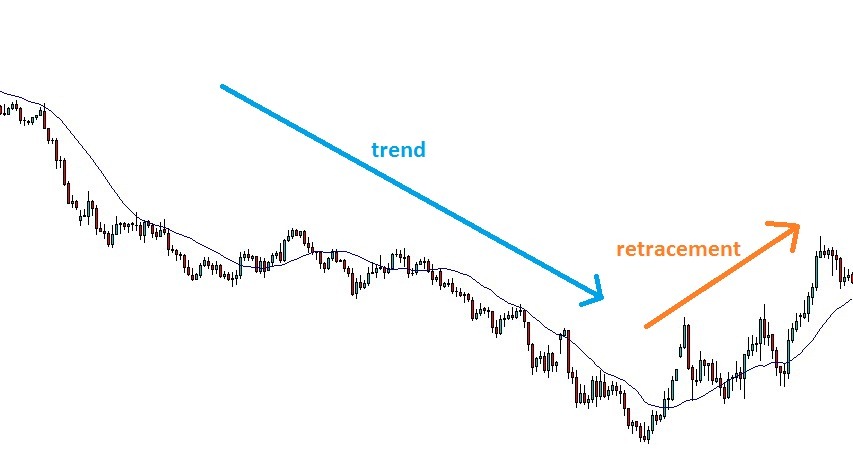
Retracement is when prices have moved in a direction either up or down, then they retrace the move.


Below is a spread betting example of a retracement. Prices retraced the original move then continued in the direction of the main trend down


retracement

Sideways Trend

What is a Sideways Trend ?
A sideways trend is when there is an equal balance between buyers and sellers, thus the price moves up and down between two levels. There is no real strength for a trend to continue in either direction.

During a sideways trend there will be strong resistance and support  levels. To break these levels you will need a substantial push either up or down.


: The yellow lines are in a consolidation phase.

: The blue lines are trend phase.

:  the Pink lines


Consolidation

Trend

What is a trend?

A trend is when prices have pushed in one direction either up or down.

An Up trend is when the lows are getting higher and the highs are also higher

A Down trend is when the lows are getting lower and the highs are also lower


Circles are getting lower

Diamonds are getting higher


Trend